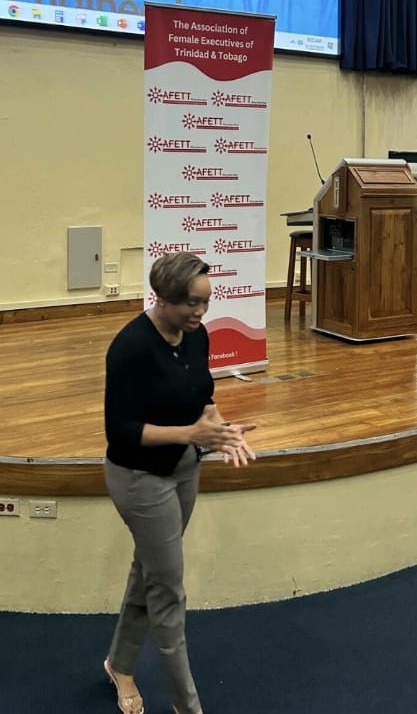
There are pivotal moments in a student’s journey when learning moves beyond theory and becomes personal. That was the experience for third-year university women in STEM who attended a powerful empowerment workshop entitled Breaking Barriers in STEM, facilitated by Nadia Byer Thomas, member of AFETT (Association of Female Executives of Trinidad & Tobago) and Director of Operations at 800 TECH Limited.
What unfolded was not a surface-level motivational talk. It was an honest, energizing, and practical conversation about confidence, identity, imposter syndrome, and the real-world skills required to thrive as a woman in STEM. Students left not only inspired, but equipped.
Nadia’s Journey: From Psychology to IT and the Power of Pivoting
Nadia opened the session by sharing a career story that resonated deeply with students navigating uncertainty about their paths. Her journey is proof that your first decision does not have to be your final destination.
She initially pursued industrial psychology, earned a scholarship, and began studies abroad. After completing a year of foundational coursework, she recognized that the discipline was not aligned with her interests. She made a bold pivot into business—an early reminder that growth often demands change.
Later, someone suggested she explore Information Technology. One course became another, and what began as curiosity developed into genuine passion. Nadia eventually graduated with two degrees Information Technology and Business Management and returned to Trinidad to explore career opportunities in industry.
A core message landed clearly: success does not require having everything figured out upfront. Progress comes from staying open to learning, adjusting when needed, and choosing what fits.
Breaking Barriers in STEM: Celebrating First-Generation Achievement
One of the most meaningful moments came when Nadia asked students to raise their hands if they were the first in their families to pursue engineering or STEM. As hands went up, she paused and let the significance sit in the room.
Being first-generation in STEM is not small or ordinary. It alters family narratives, expands what younger relatives believe is possible, and creates a blueprint for future generations. It is legacy-building in real time.
She also reminded students of something they may overlook reaching third year is not luck. It is evidence of resilience, consistency, and grit. Year three represents earned progress and a foundation for leadership.
University Is Networking, Starting Now
A common misconception Nadia challenged was that networking begins after graduation. She emphasized that university is already a networking environment, whether students recognize it or not.
Group projects, labs, meetings, and study sessions reveal critical truths about team dynamics. Students quickly learn who:
- is reliable and detailed
- disappears when work begins
- communicates clearly
- avoids responsibility
- leads under pressure
- handles conflict maturely
These insights matter because today’s classmates often become tomorrow’s colleagues. University is not only academic training it is a preview of professional behaviour.
Breaking Barriers in STEM: Confidence in Male-Dominated Spaces: “Take Up Space.”
Confidence emerged as a major theme—not as a personality trait, but as a skill that can be practiced and strengthened.
Nadia encouraged students to:
- sit upright and grounded
- occupy physical space without shrinking
- speak with clarity and intention
She gave the room a simple but unforgettable standard: “Speak at a 7 out of 10.” Not a whisper, not a hesitant 2 or 3. A confident 7.
She also shared presentation habits that translate directly into workplace presence:
- slow down
- breathe before responding
- use pauses strategically (pauses signal control, not weakness)
- practice consistently until your professional voice feels natural
Her message was clear: women do not earn respect by shrinking. They earn it by showing up fully.
Imposter Syndrome: The Antidote Is Learning and Evidence
Nadia normalized imposter syndrome as something that often appears when women enter new environments first jobs, leadership roles, or male-dominated spaces. Instead of treating it like a personal flaw, she framed it as a signal of growth.
Her strategies were straightforward and practical:
- Learn quickly and deeply.
- Build a personal system to retain information and execute well.
- Ask questions without shame.
- Use tools including AI responsibly to guide learning and organize thinking.
She also encouraged students to journal in two specific ways:
- A 5-year vision journal: not only career goals, but identity, confidence, habits, health, relationships, and lifestyle.
- A daily achievement log: one win per day, big or small.
When students can see tangible proof of their progress, the “I don’t belong here” narrative loses strength.
Career Readiness: Learn the Rules, Know Your Rights, Watch the Future
The session also addressed workplace realities in industries where women remain underrepresented, including engineering and technical environments.
Key takeaways included:
- Learn the rules of your industry.
- Know your rights and the laws that protect you.
- Understand workplace dynamics without naivety.
- Prepare for AI-driven industry shifts and stay aware of how technology intersects with your field.
Nadia encouraged students to start building experience early through:
- volunteering
- internships (including unpaid ones when safe and strategic)
- student societies
- leadership roles
Not because titles define success, but because visibility and involvement often create opportunity.
The Homework: Simple Habits That Build Unstoppable Women
Nadia closed with clear, actionable “homework” students could begin immediately:
- Journal your 5-year self (career + personal life + identity).
- Meet one new person each week to build networking confidence.
- Practice speaking at a “7” in safe spaces, so confidence transfers to harder ones.
- Take up space physically, vocally, and professionally.
- Record one achievement a day to fight imposter syndrome with evidence.
She ended on a message that tied the workshop together:
Women in STEM are not here by chance.
They are here because of their effort, and they deserve to own that.
Want to have a further conversation with Nadia? Feel free to give her a call