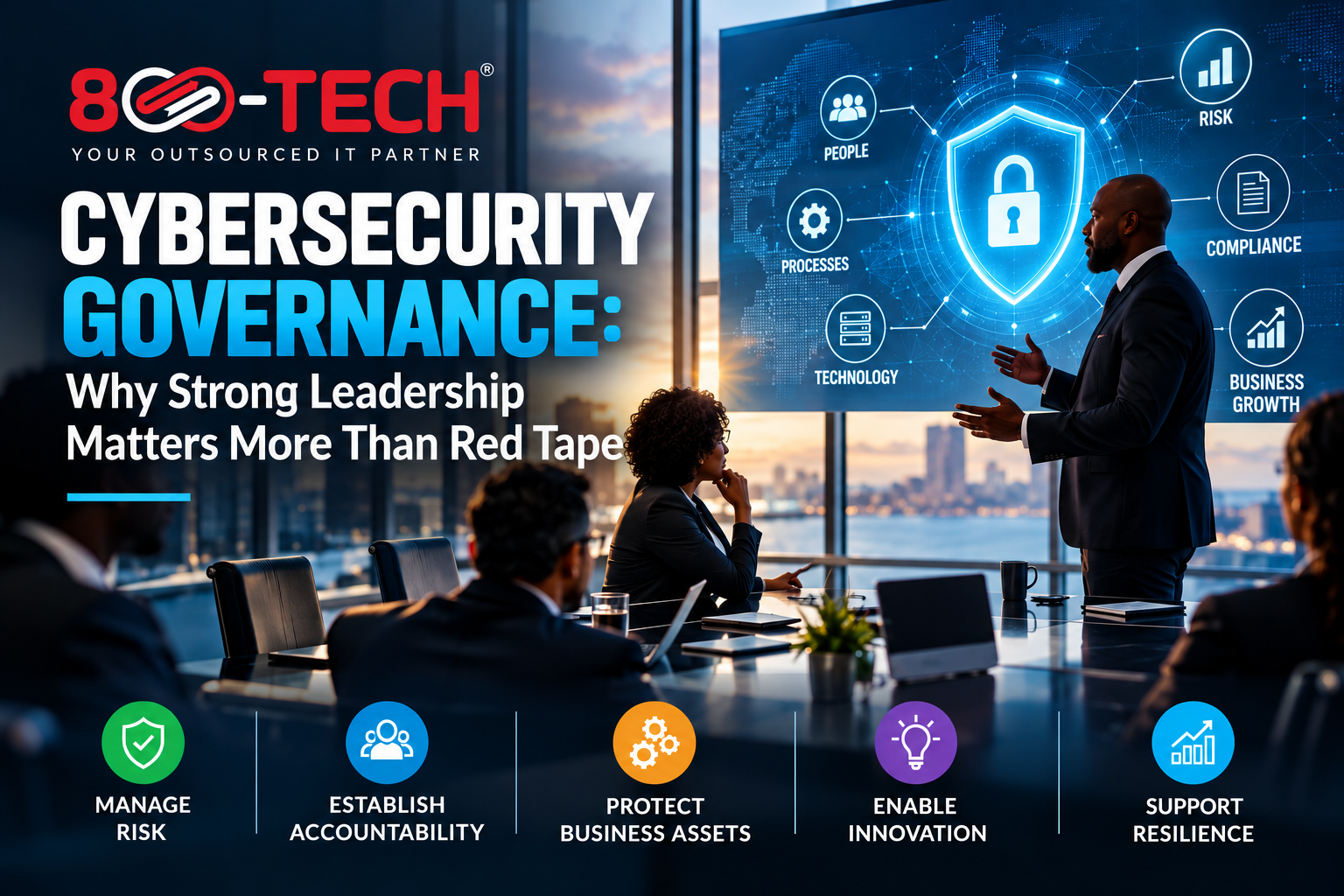
When business leaders hear the word governance, they often think of bureaucracy, lengthy approval processes, additional policies and unnecessary restrictions. However, effective cybersecurity governance should achieve the opposite. It should help organizations make informed decisions, manage risks and operate with greater confidence.
Today, nearly every business function depends on technology. Financial transactions, customer relationships, employee communications, supply chains and daily operations rely on interconnected digital systems. Consequently, a cybersecurity incident can quickly become a business crisis, affecting revenue, reputation and operational continuity.
Yet many organizations continue to approach cybersecurity primarily as an IT responsibility. They invest in sophisticated security tools, delegate implementation to technical teams and assume those investments provide adequate protection. The more important question is whether those investments support the organization’s broader business objectives.
During a recent Digital World radio discussion, 800 TECH’s Senior Cybersecurity Engineer, Junior Gilpin, highlighted a critical distinction: cybersecurity governance is about aligning an organization’s IT security strategy with its business strategy.
For CEOs, boards and senior executives, that alignment is essential. Good governance does not slow business progress. It creates the structure and accountability that allow organizations to pursue growth while managing risk.
What Does Cybersecurity Governance Actually Mean?
Cybersecurity governance establishes the oversight, responsibilities, policies and decision-making structures that guide how an organization manages cyber risk. Rather than focusing solely on technology, it connects cybersecurity priorities to the organization’s strategic objectives, operational requirements and financial considerations.
For example, a company expanding its online services may need stronger identity controls, secure payment systems and improved monitoring. Another organization may face greater risks from outdated infrastructure, excessive employee access or insufficient backup arrangements. Although both businesses need cybersecurity, their priorities will differ. Therefore, effective cybersecurity governance begins by understanding what the organization wants to achieve, what it needs to protect and which risks could prevent it from reaching those objectives.
The NIST Cybersecurity Framework 2.0 reinforces this principle through its Govern function, which emphasizes organizational context, risk-management strategy, roles, responsibilities and oversight. Importantly, governance does not require every executive to become a cybersecurity specialist. Instead, it requires leadership to establish clear expectations, assign responsibility and demand appropriate assurance.
Why Buying More Technology Does Not Automatically Mean Better Security
One of the most important points raised during the discussion was the tendency of organizations to purchase the latest cybersecurity products without first determining whether those solutions address their actual risks. A business may invest in advanced firewalls, endpoint protection, cloud security platforms and monitoring services. However, those investments may deliver limited value if the organization lacks clear policies, appropriate configurations or the expertise to manage them effectively. In other words, owning cybersecurity tools is not the same as having cybersecurity capability.
Consider a company that purchases an expensive security solution without reviewing its existing infrastructure. The organization may discover that the product duplicates capabilities it already owns, introduces compatibility challenges or fails to address its most significant vulnerability. As a result, technology spending increases without necessarily improving protection.
Cybersecurity governance helps prevent this situation by introducing oversight into technology acquisition. Before approving major investments, leadership should understand; What specific business risk does this investment address? How does the proposed solution support our strategic objectives? Will it integrate with our existing systems? Who will manage and maintain it? How will we measure its effectiveness and return on investment? These questions encourage disciplined spending and help organizations prioritize solutions that deliver meaningful business value.
Cybersecurity Governance Starts With Accountability at the Top
For many Caribbean businesses, cybersecurity responsibility still rests almost entirely with the IT department. IT professionals may manage networks, maintain devices, support employees, implement applications and respond to security incidents. However, assigning all technology-related responsibilities to one individual or department can create significant operational and governance weaknesses.
The distinction between responsibility and accountability is particularly important. An IT manager may be responsible for implementing security controls. Nevertheless, the CEO and board remain responsible for strategic decisions, resource allocation and oversight within their respective governance roles.
For example, an IT team may recommend stronger security controls after identifying a serious vulnerability. If leadership declines the investment, that decision represents a business-level acceptance of risk rather than a purely technical matter. Consequently, executives cannot simply assume that delegating cybersecurity activities transfers all accountability to IT. Strong cybersecurity governance requires leadership to understand the risks presented, evaluate the potential consequences and make informed decisions. This is why cybersecurity should form part of boardroom discussions about business continuity, operational resilience, financial exposure and corporate strategy.
Why Separation of Duties Protects the Organization
Another concern raised during the interview was the practice of allowing one IT employee to implement, approve and oversee their own work. Although this arrangement may appear convenient, it creates weaknesses in internal controls. For instance, an employee who manages administrator access, approves system changes and reviews security activity without independent oversight may unintentionally expose the organization to errors, misuse or undetected vulnerabilities.
Therefore, cybersecurity governance should establish appropriate separation of duties. The individual implementing a critical system change should not necessarily be the only person authorizing or reviewing that change. Similarly, organizations should maintain oversight of privileged accounts, system access and important technology decisions.
Smaller businesses may not have sufficient employees to separate every responsibility internally. However, they can introduce management reviews, documented approvals or independent oversight through a qualified external partner. The objective is not to create unnecessary layers of administration. Rather, it is to ensure that critical decisions receive appropriate scrutiny and that no single individual becomes an unchecked point of dependency.
Protecting Business Assets Beyond Employee Turnover
Cybersecurity governance also plays a crucial role in protecting organizational assets when employees leave or responsibilities change. Consider a business where one IT employee controls access to the company’s website, domain registration, cloud platforms, administrative accounts and critical system credentials. What happens if that employee resigns unexpectedly? Without proper oversight, the organization may struggle to access essential systems, transfer administrative responsibilities or maintain continuity.
In some cases, businesses may even lose control of important digital assets because ownership details, credentials and administrative access were never properly documented. For executives, this is not merely an IT inconvenience. It represents a direct threat to business continuity. Effective cybersecurity governance addresses this risk through clear ownership arrangements, asset inventories, documented access procedures and structured employee offboarding.
Furthermore, organizations should ensure that critical digital assets remain under appropriate corporate control rather than depending entirely on individual employees or external vendors. Ultimately, the business must retain control of the technology and information on which its operations depend.
Incident Response: Decisions Must Be Made Before a Crisis
One of the clearest demonstrations of effective cybersecurity governance occurs when an organization experiences a cyber incident. Imagine that ransomware begins spreading across a company’s network. The IT team identifies the threat and believes it must immediately isolate several critical systems. However, taking those systems offline could interrupt production, customer transactions or essential services. Who has the authority to make that decision? If the organization has not established clear responsibilities and approval arrangements, valuable time may disappear while employees seek direction.
Therefore, businesses need more than a general incident response policy. They need an actionable incident response plan supported by specific response playbooks. An incident response plan defines the organization’s overall approach to managing security incidents. Meanwhile, playbooks provide practical instructions for particular scenarios, such as ransomware, compromised accounts or website attacks. These procedures should clarify who investigates an incident, who can authorize containment actions, who communicates with customers and regulators, and when senior leadership must become involved. Additionally, organizations should establish appropriate pre-approved authority for urgent containment decisions. This allows designated personnel to act within agreed limits when immediate intervention could prevent a threat from spreading.
How Can Businesses Begin Strengthening Cybersecurity Governance?
Organizations do not necessarily need to establish a large governance department before making meaningful improvements. Instead, leadership can begin by evaluating its existing technology environment, cybersecurity responsibilities and risk-management practices.
A practical starting point involves identifying critical business assets, reviewing current security investments and determining where accountability may be unclear. From there, organizations can establish an appropriate oversight structure, such as a governance or steering committee, to guide cybersecurity priorities and important technology decisions. The committee should include relevant business stakeholders rather than relying exclusively on technical personnel.
Furthermore, management should define how the organization will assess risks, approve technology investments, monitor compliance and evaluate the effectiveness of security controls. For businesses without dedicated cybersecurity governance expertise, engaging an external specialist can provide valuable support.
At 800 TECH, we work with organizations to help them understand their technology and cybersecurity challenges, identify priorities and develop practical approaches that support their business objectives. The starting point does not have to be another software purchase. It can simply be a structured conversation about the organization’s current position and the risks that require attention.
Cybersecurity Governance Should Enable Growth, Not Restrict It
Effective governance should never become an obstacle to legitimate business progress. Instead, it should create clear boundaries within which employees, managers and technology teams can operate confidently. Consider the role of traffic regulations. They do not exist to prevent people from reaching their destinations. Rather, they establish predictable rules that help everyone travel more safely. Cybersecurity governance serves a similar purpose. It defines who can make decisions, which risks require approval, how technology investments should support business goals and what actions employees must take when something goes wrong. As a result, organizations can adopt new technologies, pursue digital transformation and expand their operations with greater clarity. More importantly, leadership gains a stronger understanding of the risks associated with those decisions.
From Technical Responsibility to Boardroom Priority
As Caribbean businesses become increasingly digital, cybersecurity governance must evolve alongside them. The challenge is no longer simply whether an organization owns the right technology. It is whether leadership understands what needs protection, who is accountable and how effectively the organization can respond when its defenses face a real test. Therefore, CEOs and boards should move beyond asking, “Do we have cybersecurity in place?” Instead, they should ask; Are our cybersecurity investments aligned with our business priorities? Do we have clear ownership and accountability for cyber risk? Can we maintain control of our critical systems and information? Have we established who makes decisions during a cyber incident? Are we governing emerging technologies such as AI appropriately? These are not simply technical questions. They are fundamental questions about organizational leadership, resilience and long-term sustainability.
Ultimately, strong cybersecurity governance does not mean introducing more red tape. It means making better decisions before circumstances force the organization to make them under pressure. The goal is not governance for the sake of compliance. It is governance that protects business value, supports responsible innovation and strengthens organizational resilience.
For more information on enhancing your Cybersecurity posture, call 223-TECH (223-8324) or click the link to schedule an assessment.