Many organizations still think about cybersecurity in much the same way they think about insurance: something they pay for in case something goes wrong. It is an understandable comparison, but it creates a dangerous mindset. Cyber insurance can help absorb part of the financial impact of an incident. Cybersecurity, however, is an active business capability that should reduce the likelihood, reach and operational consequences of that incident in the first place.
For CEOs, boards and senior executives, that distinction matters. Effective cybersecurity risk management cannot simply exist in the background as a collection of subscriptions, licenses and policies. Security controls must work while the business is changing, while employees are making decisions and while attackers are looking for weaknesses. Therefore, leadership should move beyond asking, “Do we have cybersecurity?” and start asking, “Do we know whether our cybersecurity is actually working?”
Cybersecurity Risk Management Is Not the Same as Buying Insurance
Insurance and cybersecurity both address risk, but they do so in fundamentally different ways. You would not deliberately damage a company vehicle simply to test whether its insurance policy responds. By contrast, organizations can and should test their cybersecurity before a real attacker does. Penetration testing, vulnerability assessments, phishing simulations, backup recovery exercises and incident-response testing can provide evidence of how well the organization may withstand or respond to different threats.
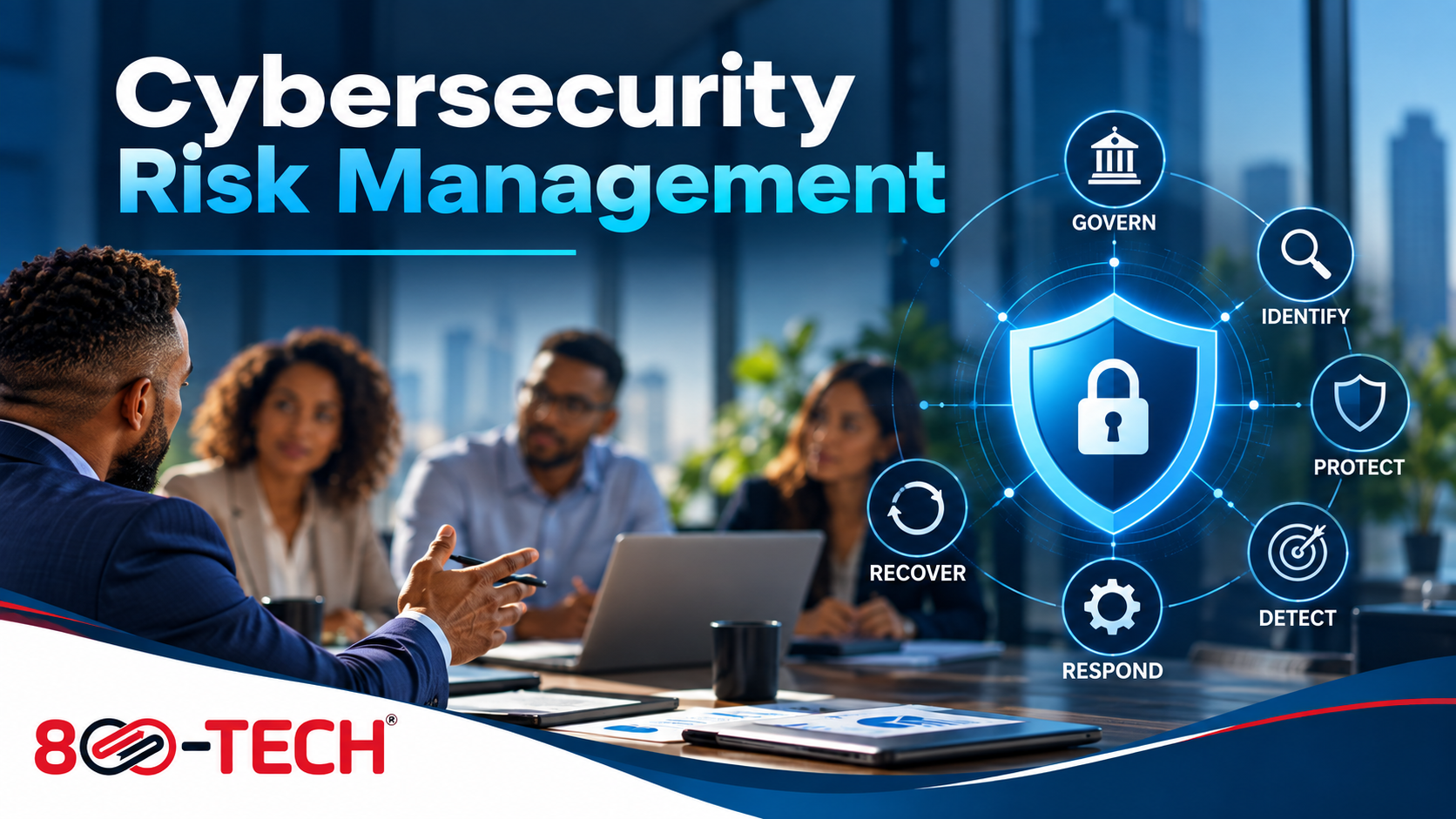
That approach aligns with the NIST Cybersecurity Framework 2.0, which organizes cybersecurity risk management around Govern, Identify, Protect, Detect, Respond and Recover. The inclusion of Govern is especially relevant to senior leadership because cybersecurity is increasingly an enterprise-risk and governance issue, not simply an IT responsibility.
In other words, cyber insurance and cybersecurity should complement each other. Insurance may help with recovery from certain losses; meanwhile, active cybersecurity should continuously reduce exposure and strengthen readiness. The mistake is not buying insurance. The mistake is treating cybersecurity with the same passive mindset.
Cybersecurity Risk Management Requires Ownership, Not Just Technology
Every organization needs someone who understands enough about its environment to determine what is working, what should be working and where the gaps may be. In some businesses, that responsibility sits with an internal IT or cybersecurity team. In others, it may be assigned to a trusted outsourced partner. Many organizations use a hybrid model. However the capability is structured, ownership must be clear.
For the C-suite, the key question is not whether the company has purchased endpoint protection, email security, multifactor authentication, backups or monitoring tools. The better question is: who is responsible for making sure those controls are configured properly, monitored consistently and tested regularly? Without clear ownership, even strong technology can create a false sense of assurance.
This is where cybersecurity risk management becomes a leadership discipline. Senior executives do not need to understand every firewall rule or investigate every security alert. Nevertheless, they do need to know who is accountable for cyber risk, how effectiveness is measured and how weaknesses are escalated before they become business-impacting events.
Paying for Cybersecurity Is Not the Same as Validating It
Businesses routinely invest in firewalls, email protection, endpoint security, MFA, backups, managed monitoring and security awareness training. These are important investments. Yet implementation should never be confused with effectiveness. A firewall can be installed but misconfigured. MFA can be enabled while other access weaknesses remain. Backups can complete successfully and still fail during restoration. Employees can complete awareness training and still struggle with a convincing business email compromise attempt.
Therefore, leadership needs evidence rather than assumptions. Security validation helps expose the difference between what management believes is protected and what is actually protected. For example, penetration testing can examine systems from an attacker’s perspective, uncover exploitable weaknesses and provide practical priorities for remediation. Likewise, tabletop exercises can reveal communication or decision-making gaps that technology alone cannot fix.
Put simply: do not just pay for security. Test it. That principle turns cybersecurity from a recurring expense into a continuously evaluated business-control system.
Continuous Business Change Creates Continuous Cyber Risk
Organizations do not stand still. New employees join, others leave, cloud applications are introduced, vendors receive access, systems are patched, remote work patterns change and new devices connect to the environment. At the same time, attackers change their methods. Consequently, an environment that appeared well protected six months ago may carry a different risk profile today.
This is why cybersecurity risk management should operate as an ongoing cycle rather than a once-a-year exercise. As the business changes, security controls should be reviewed, tested and adjusted. Moreover, meaningful changes such as a cloud migration, major application deployment, new vendor integration or merger should trigger a fresh look at security assumptions.
This approach also improves investment decisions. Instead of buying additional tools simply because a threat sounds alarming, executives can prioritize spending based on verified gaps, business criticality and potential impact. As a result, the cybersecurity budget becomes easier to defend because it is tied to measurable risk reduction.
A Suspicious Email Is Really a Test of Business Controls
Consider a suspicious email that appears to come from a trusted supplier, senior executive or service provider. It may request a payment, ask for credentials, introduce a new bank account or encourage the recipient to open an attachment. At the employee level, the immediate action is straightforward: stop, verify and escalate through the organization’s approved process.
At the executive level, however, a suspicious email tests much more than one employee’s judgment. It tests whether the organization has established clear escalation channels, whether finance teams independently verify payment changes, whether IT or the security provider can rapidly review suspicious messages, and whether employees know where to seek help without delay.
Therefore, the stronger C-suite question is not, “Will our employees recognize every phishing email?” No organization can guarantee that. The better question is, “Have we designed a process that makes one suspicious click, message or request less likely to become a major incident?”
When Compromise Is Suspected, the Response Process Should Already Exist
When suspicious activity suggests that an account may have been compromised, speed matters. However, speed without coordination can create confusion. Employees should know exactly whom to contact, while the IT or cybersecurity team should have a defined process for reviewing evidence, containing access and determining whether other users or systems may also be affected.
Depending on the situation, the response may include preserving a copy of the suspicious message, escalating it to the relevant provider or security team, independently verifying financial requests, resetting passwords, reviewing or re-enrolling MFA, terminating suspicious sessions and examining account activity. The exact steps will vary, but the principle remains the same: do not invent the incident-response process while the incident is unfolding.
For leadership, this raises another governance question: who has the authority to make critical decisions if an incident disrupts operations, customer service, payments or sensitive information? The answer should be understood before a crisis forces the issue.
Cybersecurity Risk Management Is Ultimately About Business Resilience
The strongest business case for proactive cybersecurity is not technical. It is operational. A cyber incident can interrupt revenue, prevent employees from accessing essential systems, delay customer service, expose confidential information, disrupt supply chains and create significant recovery costs. Therefore, cybersecurity belongs in the same executive conversation as business continuity, operational resilience, financial risk and corporate reputation.
For the board and executive team, three questions can quickly reveal whether the organization has moved beyond a checkbox mindset: What could realistically go wrong? How prepared are we to prevent, contain and recover from it? And how do we know? The third question is often the most important because it forces the organization to demonstrate evidence rather than rely on confidence.
Without testing and validation, leadership may be relying on assumptions that have never been proven. With validation, executives gain better visibility into the organization’s actual exposure, can prioritize remediation more effectively and can make more informed decisions about technology, staffing, outsourcing and cyber insurance.
Internal Expertise, Outsourced Support or a Hybrid Model?
Not every organization needs a large internal cybersecurity department. However, every organization needs access to the right expertise. For some businesses, that capability can be built internally. For others particularly small and mid-sized organizations outsourcing part or all of the function can provide access to specialized skills, monitoring and response capabilities without the cost of building an equivalent team in-house.
At 800 TECH, our cybersecurity and managed IT services are designed to help organizations reduce the burden of managing security alone while improving visibility, validation and response. Whether the model is internal, outsourced or hybrid, the objective remains the same: someone must be actively responsible for protecting the environment and confirming that the controls continue to work.
Move From “We Have Cybersecurity” to “We Know It Works”
Organizations often move through three levels of cybersecurity maturity. First comes acquisition: we bought security tools. Next comes implementation: we deployed those tools. The more mature stage is validation: we have evidence that our controls work, we understand our weaknesses and we know what should be improved next.
That third stage is where cybersecurity risk management becomes most useful to the C-suite. Rather than measuring progress by the number of products purchased, leadership can measure whether exposure is decreasing, whether resilience is improving and whether the business can respond effectively when conditions change.
The worst time to discover that a security control does not work is during a real cyberattack. Likewise, the worst time to learn that employees do not know whom to contact is after an account has been compromised. The worst time to discover that backups cannot be restored is during an outage. And the worst time to assign incident-response responsibilities is while the organization is already under pressure.
Cybersecurity should therefore be monitored, challenged and tested before the business is tested by an attacker. When leadership can move from “we think we are protected” to “we have tested our defenses and know where we stand,” cybersecurity becomes more than an IT expense. It becomes a measurable component of business resilience.
For more information on strengthening your organization’s security posture, call 223-TECH (223-8324) or click the link to schedule an assessment