A business continuity plan is only as strong as its people
Your business continuity plan lists the production manager, sales lead and communications officer. But have those employees ever rehearsed their responsibilities? If not, the document may offer comfort without operational readiness.
At 800 TECH’s webinar, Scofield Thomas described plans that named key employees who did not understand why they appeared in the document. Consequently, a crisis could begin with confusion instead of coordinated action. Business continuity plan roles and responsibilities must extend beyond names on a page.
Assign ownership to the people who run the processes
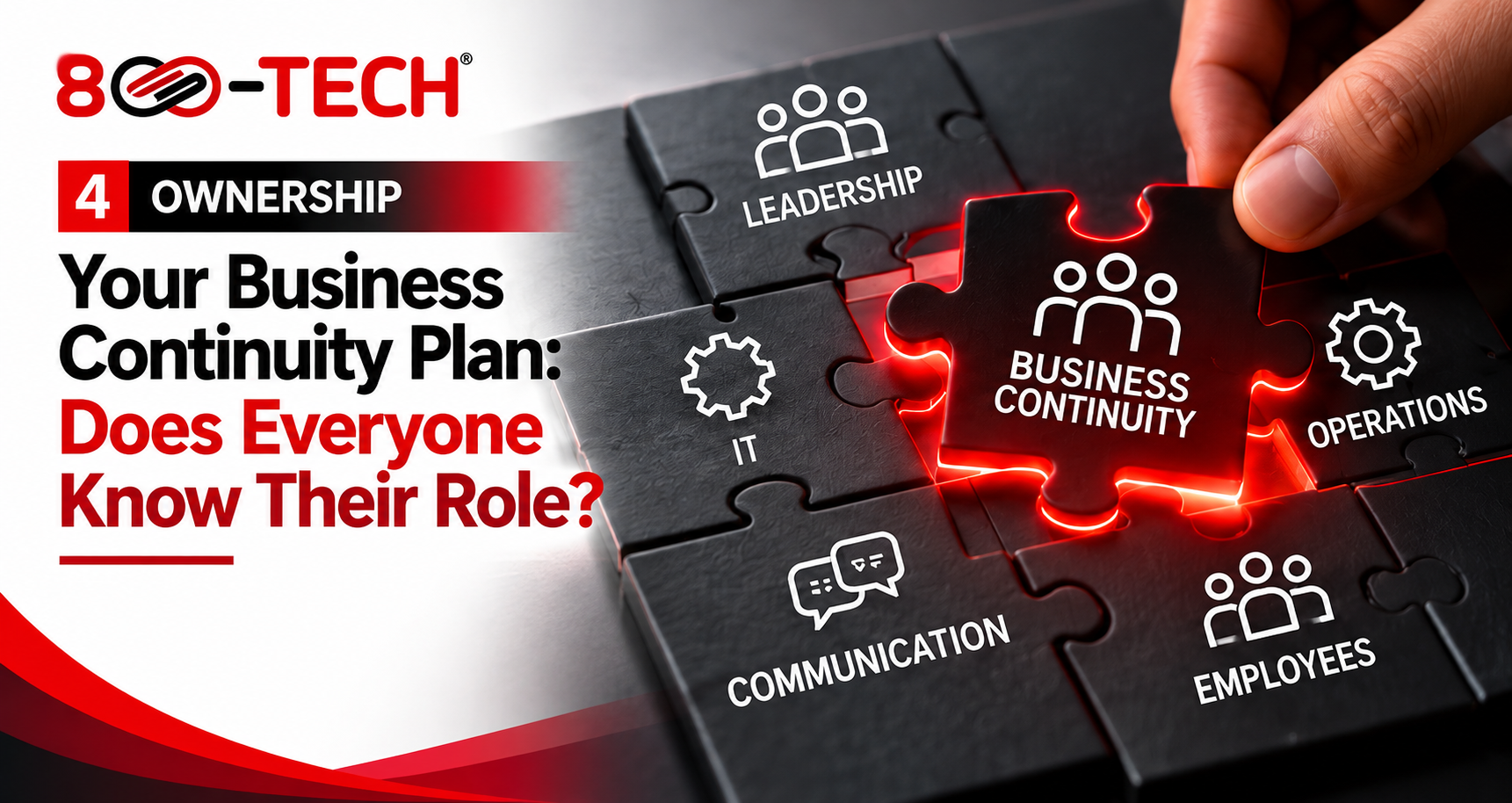
The IT department can restore infrastructure, but it cannot alone decide which customer orders take priority or how manufacturing should operate manually. Therefore, each critical process needs a business owner, a deputy and a clearly defined recovery task.
For example, a Caribbean distribution company may need operations to authorize manual dispatch, finance to validate payment records and customer service to communicate delays. Meanwhile, IT coordinates system restoration. Together, these functions protect the wider business.
Train people and rehearse realistic scenarios
Junior Gilpin compared continuity roles with first-aid and fire-warden responsibilities: organizations train those employees before emergencies. Yet some companies never train the staff listed in continuity plans. A practical exercise should show each participant what to do, whom to contact and which decisions require approval.
Start with a tabletop exercise that removes access to a cloud CRM and email. Ask the customer service lead to retrieve approved contact details and notify clients. If that person cannot act, the exercise has revealed a useful gap before a real disruption.
Three improvements to business continuity plan ownership
First, create a responsibility matrix for each critical service, with named primary and backup owners. Second, provide role-specific training and rehearse decisions across departments. Third, maintain controlled offline copies of essential contacts, procedures and message templates, updating them according to business risk.
Scofield highlighted the danger of storing all customer contact information in a cloud system that might itself become unavailable. Accordingly, offline access and periodic verification should form part of the continuity process.
How often should continuity roles be reviewed?
Review responsibilities when personnel, systems, or suppliers change, and rehearse them on a risk-based schedule. Additionally, revisit the plan after exercises and incidents so owners can correct weaknesses. A plan becomes more useful when teams treat it as a working operational tool.
Explore the related articles on critical system downtime and the first hours of incident response.
Give every role a practical first task
A responsibility matrix works best when it describes actions rather than titles alone. The operations lead may decide which services continue manually. Finance may establish how to process urgent payments safely. Communications may prepare customer updates, while the technical team works to restore systems. Each role also needs an alternate person and an escalation route.
For example, if a distributor loses access to its online customer relationship management platform, sales should know where to find an approved offline contact list. Customer service should know which messages it may send, and leadership should decide when to escalate delivery delays. Without this preparation, departments may duplicate work or communicate conflicting information.
Use exercises to build confidence and improve the plan
A tabletop exercise does not require an expensive simulation. Gather the people named in the plan, describe a plausible disruption and ask them to explain their next actions. Then introduce a complication: the usual communications platform is unavailable, the primary decision-maker is absent, or a major customer requests an immediate update.
Record the decisions, unanswered questions and gaps in available information. Afterward, assign an owner and deadline to each improvement. Repeat the scenario once changes take effect. In this way, continuity planning becomes a cycle of training, testing and improvement rather than an annual document-signing exercise.
Questions to take into your next leadership meeting
- Can each named employee explain their first action during a continuity event?
- Do deputies know how to access essential procedures and contacts offline?
- What did our most recent tabletop exercise reveal, and who closed the gaps?
For a practical starting point, leadership can review the webinar recording: Before the breach: Five-questions every Board must ask
Related reading:
How Long Can Your Business Operate Without Critical Systems?
What Should Leaders Do in the First Hours of a Cyber Incident?
For more information on strengthening your organization’s security posture, call 223-TECH (223-8324) or click the link to schedule an assessment.