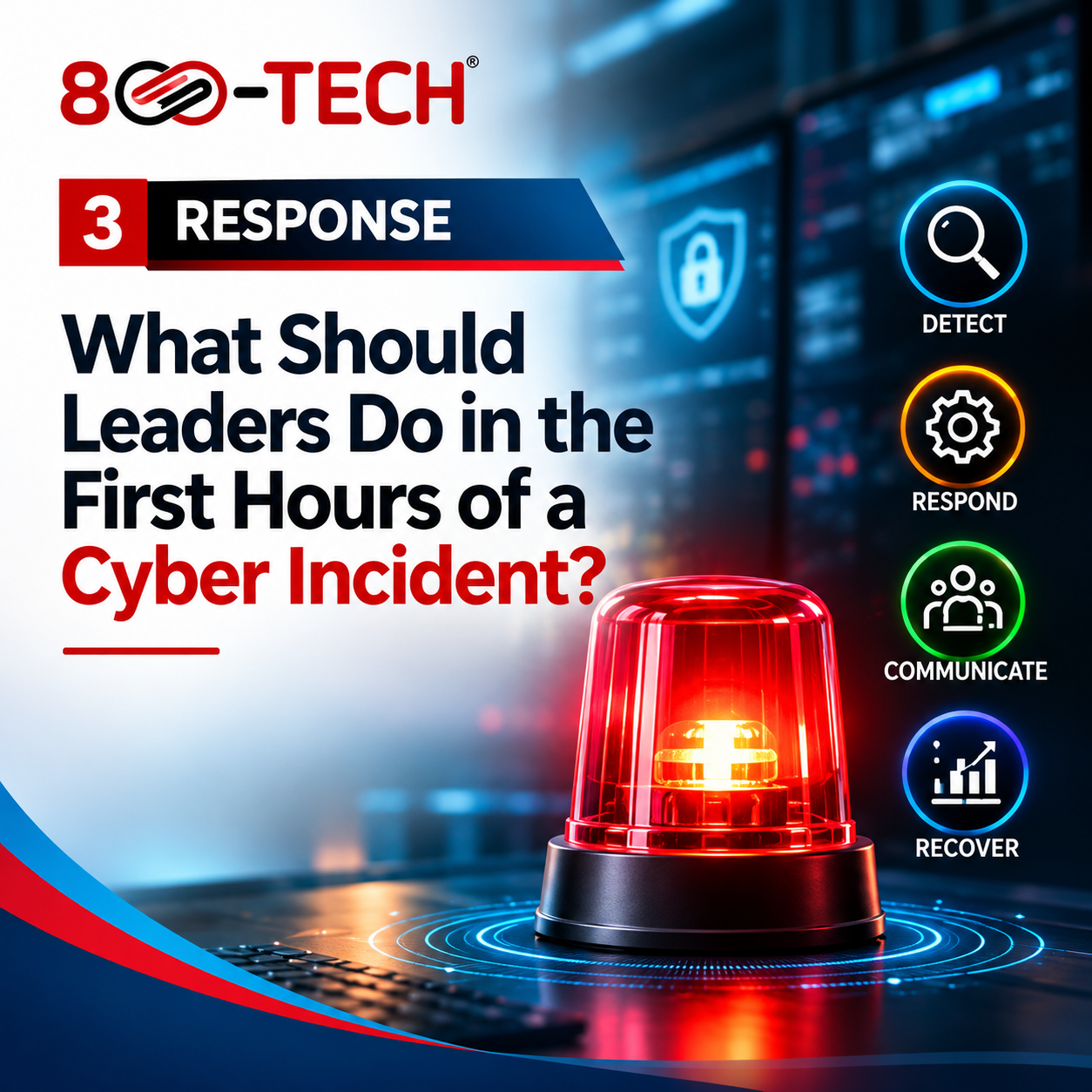
The first hours should activate a cyber incident response plan
A finance employee notices unusual messages from a trusted supplier. Soon afterward, colleagues report suspicious sign-in activity. Should the organization disable an account, halt payments or contact customers? Without a cyber incident response plan, teams may spend the most important hours debating who can make those decisions.
During 800 TECH’s webinar, IT Manager Drew Bejai emphasized that response depends on the scope and severity of the event. A suspicious email, a compromised account and an organization-wide outage do not require identical actions. However, each needs a defined route for assessment and escalation.
Separate detection, escalation and decision authority
First, establish who receives alerts and who investigates them. Next, specify when technical staff must notify executives, legal advisers or external specialists. Finally, identify who can approve disruptive containment actions, emergency spending and customer notifications.
Junior Gilpin also warned against treating every security event as a confirmed breach. Therefore, communication must follow verified facts and appropriate specialist advice. A premature public statement can create confusion and reputational damage.
Plan communications when normal systems are unavailable
A cyber incident may also affect email, Microsoft Teams or a cloud-based CRM. In that situation, the company cannot rely exclusively on the very systems that have failed. Instead, maintain protected offline contact details, approved message templates and alternate channels for staff, customers and key suppliers.
Consider a Trinidad and Tobago professional services firm that discovers fraudulent instructions from a legitimate mailbox. The response team needs to secure access and verify affected messages. Meanwhile, authorized staff must contact recipients through a trusted independent channel to prevent further harm.
Three steps to strengthen cyber incident response
First, document an escalation matrix with named contacts, alternates and emergency approval limits. Second, prepare communication procedures for employees, customers, insurers and relevant authorities, with legal review where needed. Third, conduct a tabletop exercise that simulates an account compromise and a simultaneous email outage.
Marcela Coronell emphasized testing rather than simply filing a plan. Likewise, Drew highlighted employee awareness and verification of unusual requests, even when a message appears to come from a familiar sender.
Who should speak publicly during an incident?
An authorized spokesperson should coordinate with the incident lead and appropriate legal or regulatory advisers. The organization should confirm what it knows, what remains uncertain and which audiences require notification. As a result, technical investigation and public communication can proceed without contradictory claims.
Read the related article on business continuity ownership to understand why named roles and rehearsal matter.
Build a decision timeline for the first hour
An incident response plan should specify the first actions without assuming that every alert is a breach. The designated team first records what happened and preserves relevant information. Next, qualified personnel assess the scope and advise on containment. Management then decides whether the situation requires wider escalation, alternate operations or carefully coordinated notifications.
The plan should also name a backup decision-maker. If the managing director is travelling or unreachable, employees cannot wait indefinitely for approval to isolate a compromised account or engage specialist assistance. Pre-agreed spending limits and emergency contacts reduce that delay, a practical measure Scofield Thomas described during the webinar.
Why trusted suppliers require special attention
Attackers may use a genuine supplier mailbox after gaining access to it. As Drew Bejai explained, the familiar sender can make a fraudulent message seem credible. Therefore, staff should independently verify unexpected bank-detail changes, urgent transfers and unusual requests through a previously confirmed telephone number or another trusted channel.
This verification process belongs in both employee training and the response plan. If someone acts on a suspicious message, the organization needs a clear reporting route, even when the employee feels embarrassed. Early reporting gives the response team more opportunity to investigate, contain the issue and warn other affected parties when appropriate.
Questions to take into your next leadership meeting
- Who can authorize account isolation, emergency expenditure and customer communications?
- How will we reach staff and clients if our normal email and collaboration tools fail?
- When did we last practise the escalation process with senior leaders?
For a practical starting point, leadership can review 800 TECH 4th annual webinar and gain additional external guidance by reviewing the Incident Response Plan (IRP) Basics published by Cybersecurity & Infrastructure Security Agency (CISA).
For more information on strengthening your organization’s security posture, call 223-TECH (223-8324) or click the link to schedule an assessment.