

Many businesses are challenged with driving efficiency and productivity in their environment.
Our experience of being in the business technology arena for over 17 years has exposed us to many habitual problems throughout all the different sectors.
Problems such as lack of standardization for company’s processes, departments functioning in silos, and delayed collation of data that is critical for decision making. When we recognized that these problems were a common thread through different organizations, we developed a solution that can drive business in a more efficient and productive manner.
That was the birth of the Digital Business Eco-system (DBE).
The Digital Business Eco-system can be subdivided into two key components:
- The Business Process Reengineering (BPR) and
- The Business Productivity Tools (BPT)
Utilizing these 2 components in your business will drive efficiency and productivity in your business.
Business Process Reengineering helps leaders in the organization to understand what their Current State is. Then, these processes are redefined and re-engineered to make them more efficient (i.e. Future State). For example, in most organization applying for vacation leave can take approximately 1 to 2 weeks. This bottleneck occurs for myriad of reasons:
- The recurring loop between HR and the employee and HR and the supervisor to determine the number of days available
- Loss of documentation
- Submission of an incomplete form
- Lack of real-time data to ensure sufficient resources are available when the employee goes on leave.
Business Productivity Tools are used to integrate into those processes to make them efficient and effective. BPT converts a process such as applying for leave – that manually can take 1 to 2 weeks into a few hours from application to approval. BPT will eliminate the bottleneck providing real-time data analytics for quick decision making.
The key advantages of BPT in an organization are as follows:
- Enables a centralized data repository for company productivity tools.
- Help businesses manage their data, processes, and departments easily through personalized views.
- Facilitates interdepartmental collaboration
- Enables the standardization of workflow processes that takes place in the background of these productivity tools.
- Supports trackability and auditability of business processes.
With these two components married together, it allows for collaboration of the departments to remove the silos that we experience. The data that is being generated by each department is readily available and can now be used by executives to make key and quick decisions.
Schedule a call with us to learn more about how the Digital Business Eco-system can be implemented in your business to increase your productivity.
Our Blog
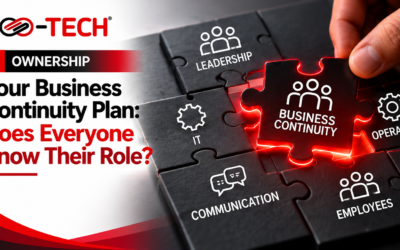
Your Business Continuity Plan: Does Everyone Know Their Role?
A business continuity plan is only as strong as its people Your business continuity plan lists the production manager, sales lead and communications officer. But have those employees ever rehearsed their responsibilities? If not, the document may offer comfort...

Cyberattacks Are Getting Faster. Is Your Business Ready to Respond?
800 TECH | EXECUTIVE CYBER BRIEF 18 NOVEMBER 2026 | 2-MINUTE READ The business issue: Cybercriminals are using artificial intelligence to automate attacks against businesses, reducing the time and effort needed to identify weaknesses, exploit systems and gain...

What Should Leaders Do in the First Hours of a Cyber Incident?
The first hours should activate a cyber incident response plan A finance employee notices unusual messages from a trusted supplier. Soon afterward, colleagues report suspicious sign-in activity. Should the organization disable an account, halt payments or contact...

How Long Can Your Business Operate Without Critical Systems?
Which critical systems keep your business operating? Imagine a Caribbean manufacturer whose production scheduling system becomes unavailable during a busy delivery week. Employees may still arrive at work, yet orders, dispatch and customer commitments quickly suffer....

Who Is Accountable for Cybersecurity in Your Business?
Why cybersecurity accountability belongs in the boardroom? A supplier’s compromised account can cause your organization’s problem overnight. When a payment instruction changes or a customer cannot access a service, clients will look to the business, not its IT...

Cybersecurity Governance: Why Strong Leadership Matters More Than Red Tape
When business leaders hear the word governance, they often think of bureaucracy, lengthy approval processes, additional policies and unnecessary restrictions. However, effective cybersecurity governance should achieve the opposite. It should help organizations make...
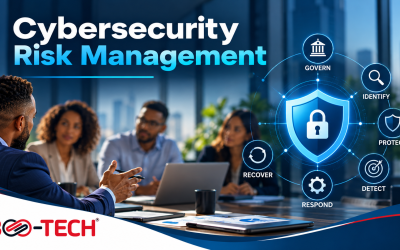
Cybersecurity Risk Management: Don’t Just Pay for Security, Test It!
Many organizations still think about cybersecurity in much the same way they think about insurance: something they pay for in case something goes wrong. It is an understandable comparison, but it creates a dangerous mindset. Cyber insurance can help absorb part of the...
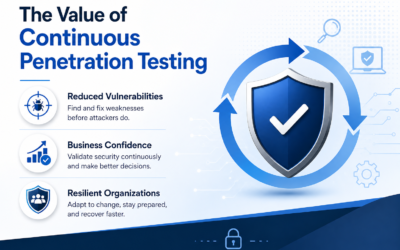
Continuous Penetration Testing: Why Modern Businesses Must Continuously Validate Security
Why Continuous Penetration Testing Matters Business environments never stand still. Every software update, cloud migration, vendor integration, employee onboarding, or configuration change introduces new opportunities for cyber attackers. Therefore, organizations can...

Business Cybersecurity: Why It’s No Longer Just an IT Issue
Business Cybersecurity Is About Business Survival For years, many organizations viewed cybersecurity as the responsibility of the IT department. However, today's business environment tells a different story. Every new employee, cloud application, software update, AI...